ISO 14001:2026 – What Has Changed and What It Means for New Zealand Businesses
Environmental management continues to evolve as organisations face increasing expectations from customers, regulators, supply chains, and communities. With the publication of ISO 14001:2026, certified organisations now have an opportunity to strengthen their Environmental Management Systems (EMS) and align with current environmental priorities.
While the revised standard is not a complete rewrite, it introduces several important changes designed to improve environmental performance, strengthen leadership accountability, and support more effective risk-based decision-making.
For New Zealand businesses currently certified to ISO 14001:2015, now is the time to understand the changes and begin planning for transition.
Why the Update Matters
Environmental expectations continue to grow from customers, regulators, investors, and supply chain partners. ISO 14001:2026 helps organisations respond to these expectations by ensuring environmental management is integrated into everyday business operations and strategic decision-making.
The revised standard focuses on delivering measurable environmental outcomes rather than simply maintaining documented processes.
Key Changes in ISO 14001:2026
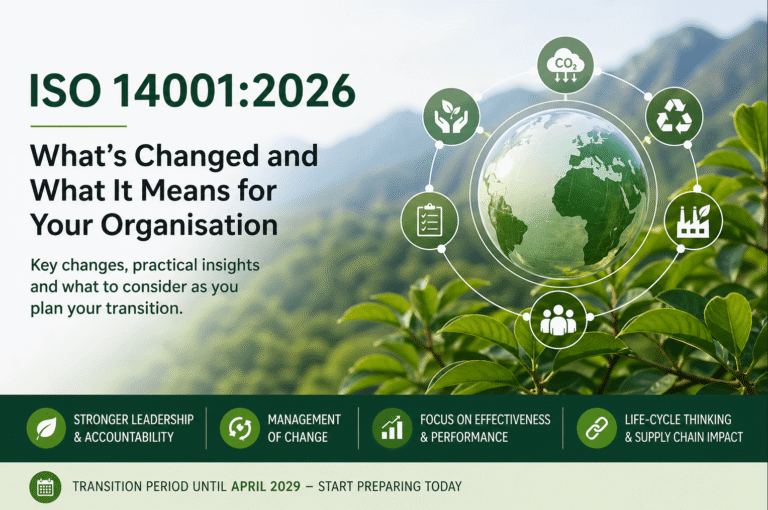
Stronger Leadership Accountability
Senior management is expected to take greater responsibility for the effectiveness of the Environmental Management System. Leadership must actively support environmental objectives, performance improvement, and compliance obligations.
Enhanced Environmental Context
Organisations must better understand the environmental issues that may affect their operations and the impacts their activities have on the environment. This may include: Climate change, Resource availability, Biodiversity, Pollution prevention, Waste management and Local environmental conditions.
Greater Focus on Risks and Opportunities
Environmental risks and opportunities must be more closely linked to business planning and operational decision-making.
Organisations should be able to demonstrate how they identify, assess, monitor, and manage environmental risks.
Life-Cycle Thinking and Supply Chain Management
Businesses are expected to consider environmental impacts throughout the lifecycle of their products and services.
This includes reviewing: Suppliers and contractors, Procurement activities, Transport and logistics, Packaging, including Waste and end-of-life impacts.
Management of Change
The updated standard strengthens requirements for managing environmental impacts when significant changes occur within the organisation.
Examples include: New equipment, New facilities, New suppliers, New products or services and Changes to legislation.
What New Zealand Businesses Should Do Now?
To prepare for the transition to ISO 14001:2026, organisations should:
☐ Conduct a gap analysis against the new requirements
☐ Review environmental risks and opportunities
☐ Update environmental policies and objectives
☐ Strengthen supplier and contractor environmental controls
☐ Review environmental aspects and life-cycle impacts
☐ Assess climate-related and environmental context considerations
☐ Review change management processes
☐ Train employees and leadership teams on the updated requirements
☐ Conduct internal audits against ISO 14001:2026
☐ Complete a management review of transition readiness
☐ Address any identified gaps or nonconformities
☐ Engage with your certification body early to discuss transition requirements and timelines
Starting early will help ensure a smooth, efficient and cost-effective transition while maintaining confidence in your Environmental Management System and certification status.